
The Warm Homes Plan: What Homeowners Need to Know
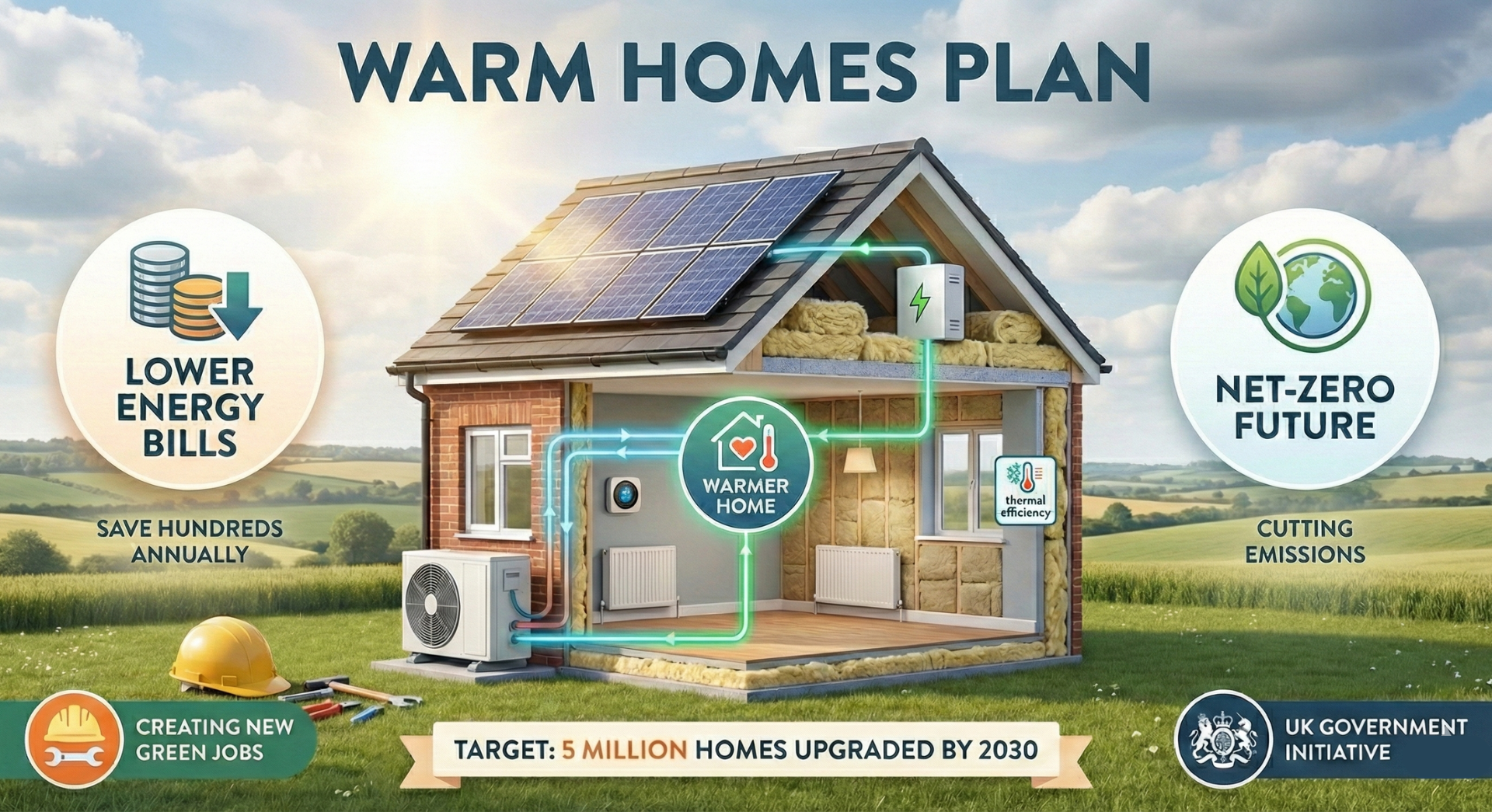
The government has introduced the Warm Homes Plan, a long-term initiative designed to make homes warmer, more energy-efficient, and cheaper to run. As part of the wider net-zero strategy, the plan focuses on reducing carbon emissions from housing while helping households manage rising energy costs.
Heating accounts for a large proportion of household energy use, which is why low-carbon heating solutions — particularly air-source heat pumps (ASHPs) — play a central role in the Warm Homes Plan.
What Is the Warm Homes Plan?
The Warm Homes Plan is a government-backed programme that brings together grants, loans, energy efficiency upgrades, and regulatory changes. Its main goals are to:
- Improve the energy performance of homes
- Reduce fuel poverty
- Cut household energy bills
- Support the transition away from gas boilers
Rather than being a single scheme, the Warm Homes Plan acts as an umbrella for several funding routes and policies that support low-carbon heating and insulation upgrades.
Financial Support Available
One of the most important elements of the Warm Homes Plan is financial assistance. To help homeowners manage upfront costs, the government offers a mix of grants and affordable finance options.
- The Boiler Upgrade Scheme (BUS) provides grants of up to £7,500 towards the cost of installing an ASHP. This is open to most homeowners in England and Wales replacing a fossil fuel heating system.
- In addition to grants, the plan introduces low- or zero-interest loans for home energy improvements. These can be used for heat pumps, insulation, solar panels, batteries, and heating controls, allowing costs to be spread over time.
Improving Energy Efficiency First
The Warm Homes Plan places strong emphasis on energy efficiency. Heat pumps work most effectively in homes that are well insulated and retain heat efficiently. To support this, the plan encourages improvements such as:
- Loft and cavity or solid wall insulation
- Draught-proofing doors and windows
- Upgraded heating controls and thermostats
By improving insulation before or alongside installing an ASHP, households can maximise system performance and reduce running costs.
Easier Installation and Planning
Another key focus of the Warm Homes Plan is simplifying the installation process. Historically, planning rules and uncertainty around permissions have discouraged some homeowners from installing heat pumps.
- Relaxed planning restrictions: Planning permission is no longer required for most standard ASHP installations, and rules on unit size, noise levels, and placement have been clarified.
- Clear guidance: The government provides detailed advice to help homeowners and landlords understand building regulations, installation requirements, and preparation steps.
- Support for landlords: Rental properties are guided towards meeting Minimum Energy Efficiency Standards, including the target for homes to reach EPC Band C by 2030.
These measures remove barriers and make adopting low-carbon heating much easier.
Unlike older schemes aimed at low-income households, the Warm Homes Plan is now accessible to most homeowners and landlords. By combining grants, energy efficiency upgrades, and simpler installation rules, it provides a clear pathway to low-carbon heating.
At Wimbledon Heat Pumps, we can help you navigate the plan, claim the BUS grant, and install an air-source heat pump efficiently, so your home stays warm, energy-efficient, and future-ready.